Review: My Heart is on That Field Design for Embroidery
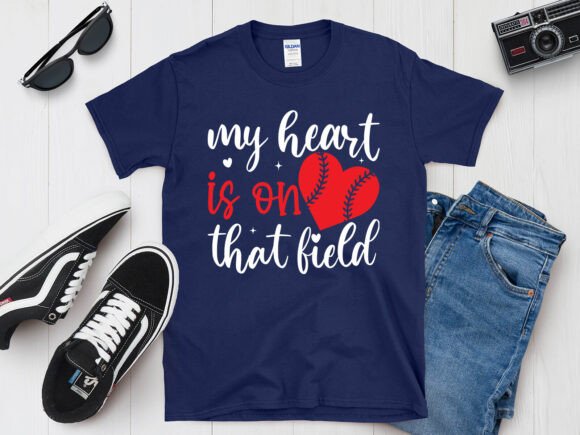
As a designer who spends more time staring at stitch simulations than actual fabric, I approach new design assets with a healthy dose of skepticism. We have all seen those cute Graphics that look perfect on a screen but turn into a tangled mess of thread breaks and puckering once they hit the hoop. Today, I am taking a close look at the My Heart is on That Field T-Shirt Design. While the product description markets it primarily as a funny T-Shirt Design for prints and stickers, my job is to evaluate its potential as a viable machine embroidery design for real-world applications.
The first impression of this layout is one of playful sentimentality. The phrase "My Heart is on That Field" immediately evokes images of Saturday morning soccer games, little league baseball, or high school football sidelines. Visually, the typography appears bold enough to carry the message, but the true test lies in how those curves and angles translate into satin and fill stitches. For an Etsy seller or a small shop owner, the mood this piece creates is crucial. It needs to feel supportive and proud, not cluttered or amateurish. If the letter spacing is too tight, the stitch density will cause the threads to merge, ruining the readability that makes the joke work in the first place.
Putting the Design to the Test: A Real-World Scenario
To truly understand the value of this file, I imagined a specific project: a custom order for a local mom who wants matching outfits for her family during the upcoming fall sports season. She requested a sweatshirt embroidery project for herself and a tote bag design for carrying snacks and water bottles. This is where the My Heart is on That Field T-Shirt Design shines conceptually. It fits perfectly into the niche of custom apparel meant for spectators rather than players.
However, executing this requires careful planning. On a fleece sweatshirt, the fabric texture can be tricky. If the design relies heavily on long running stitch outlines without adequate underlay, the text might sink into the pile of the fabric, making it look uneven. Conversely, if the design is digitized with too much fill stitch, it could create a stiff, cardboard-like patch on a garment meant to be cozy. For the tote bag, which likely uses a heavier canvas, the design would hold up better, allowing for crisper edges and more vibrant thread colors. The key here is adaptability; a good embroidery file should look professional whether it is stitched onto a thin poly-blend tee or a thick cotton canvas.
Navigating Technical Challenges and Fabric Choices
Every designer knows that not every graphic is ready for the needle. When working with the My Heart is on That Field T-Shirt Design, there are specific areas where caution is required. If you are planning to use this on a cap, the curved surface demands a design with minimal width and strategic stitching directions to prevent distortion. Small details, like the cross of a "t" or the curve of a heart icon if included, need to be inspected closely. If these elements are too small relative to your hoop size or machine capability, they may not stitch out cleanly.
Furthermore, consider the background. The description mentions usage on mugs and banners, but for embroidery, dark fabrics present a unique challenge. If the design does not include a built-in underlay or if the digitizer did not account for contrast, white or light-colored text on a navy blue jersey might look washed out. In these cases, you might need to manually adjust the thread colors or add a backing layer to ensure the pop you see in the digital preview translates to the finished product. Stretchy fabrics also require a robust stabilizer strategy. Without proper support, the movement of the fabric during washing could cause the stitches to pucker, distorting the funny message into something unreadable.
Commercial Viability and Brand Consistency
For craft business owners, the visual appeal of a design directly impacts customer trust and buyer engagement. The My Heart is on That Field T-Shirt Design has the potential to be a bestseller during sports seasons if presented correctly. It taps into the emotional connection parents and partners have with athletes. However, professionalism is key. A sloppy stitch-out reflects poorly on your brand, regardless of how cute the saying is. Ensuring that the satins stitch coverage is smooth and that there are no loose jump stitches between letters is essential for maintaining a high perceived value.
This design also works well for personalized gifts beyond just clothing. Imagine an embroidered patch sewn onto a backpack or a pillow cover for a dorm room. These applications extend the life of the design beyond the typical t-shirt lifecycle. For commercial embroidery projects, consistency is vital. If you are selling this as part of a collection, ensure that the scale of this design matches your other offerings so that customers can mix and match items without the branding looking disjointed.
Practical Notes for the Studio
Before you commit to stitching this on a client's expensive garment, follow these practical steps. First, always test the design on scrap fabric that mimics the final material. Check the stitch count and density; if the area feels too stiff, you may need to reduce the density in your editing software. Second, review the licensing terms carefully. The product description states it can be used for t-shirts, stickers, and more, but as a digital embroidery file user, you must confirm if the license covers commercial embroidery sales or if it is for personal use only. Never assume.
Additionally, create black and white mockups to check the contrast and shape integrity without the distraction of color. Compare how the design looks on both light and dark backgrounds to anticipate any visibility issues. Finally, inspect the small corners and detailed areas. If the design includes intricate swirls or tiny hearts, verify that your machine can handle the resolution. If the provided file formats do not match your machine, ensure you have the tools to convert them without losing quality.
In conclusion, the My Heart is on That Field T-Shirt Design offers a charming concept with strong potential for holiday embroidery gifts, team merchandise, and boutique products. However, its success relies entirely on the quality of the digitization and the skill of the operator. By paying attention to fabric choice, stabilizer use, and stitch clarity, you can transform a simple graphic into a cherished handmade product that resonates with sports families everywhere. Treat it with the technical respect it requires, and it will become a reliable asset in your small shop product lineup.